
Is It Too Late to Change Careers? An 86-Year-Old's Answer Will Surprise You
On ambition, motherhood, and why life is long enough to try again
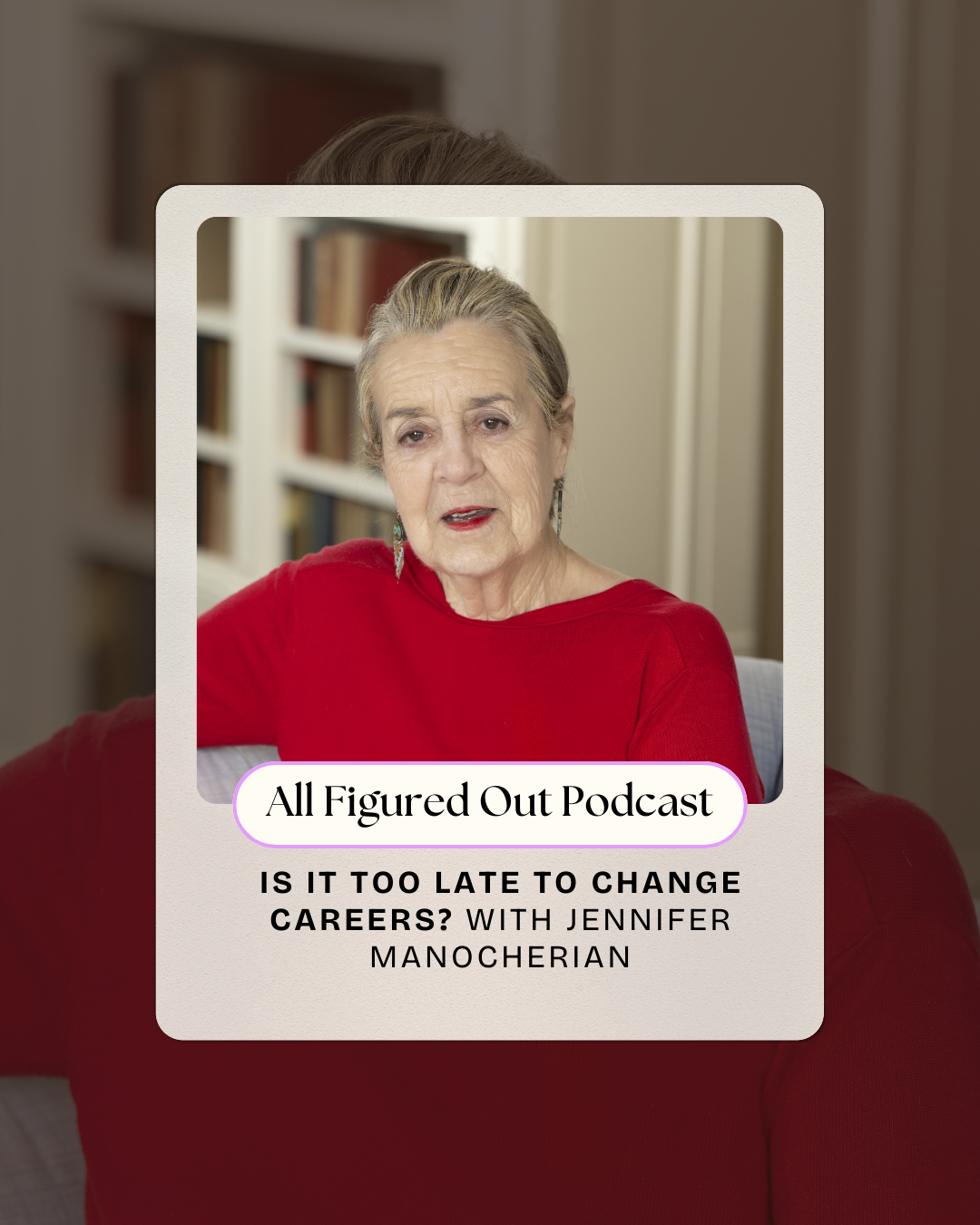
Episode 110. 4 Kids by 27, Broadway by 50: Life is Long Enough to Reinvent with Jennifer Manocherian
You Don't Need It All Figured Out by 40 (Or 50, or 60...)
If you're a working parent feeling the pressure to have your career perfectly mapped out, hitting certain milestones by specific ages, or secretly wondering if you've already missed your window for a big pivot—I need you to meet Jennifer Manocherian.
At 86 years old, Jennifer is writing her second novel, developing a musical series for streaming, and creating art installations from mannequins in her spare time. But what makes her story so powerful for ambitious parents is that she didn't figure any of this out on a linear timeline. She had four kids by age 27, right as the women's movement was gaining momentum. She got her undergraduate degree at 34 while having her fifth child. She became a Broadway producer in her 50s. She published her first novel decades later.
And she's still not done.
Jennifer's career path reads less like a strategic plan and more like a series of bold experiments—some that worked, some that didn't, and all of them teaching her something about what she actually wanted from life.
The Guilt of Ambitious Motherhood
Let's talk about the thing Jennifer said that made me pause the recording and just sit with it:
"I wanted to be everything to my children. My mother was always preoccupied with things she was doing, and I just wanted to be everything to my children. And it was Mission Impossible. It really was."
Jennifer didn't sugarcoat the tension between career ambition and parenting. She talked openly about the guilt she lived with—choosing to travel for theater productions while her youngest struggled at home, bringing a younger sibling along to a Girl Scout trip that should have been one-on-one time with her older daughter, constantly feeling like she was failing at being present.
But here's what's different about Jennifer's approach to that guilt: she didn't let it stop her from pursuing the work that mattered to her.
When Broadway producing became too demanding and took her away from her family too much, she shifted her involvement. She pivoted. When working in her husband's business created tension in their marriage, she walked away and found something else. She took her temperature, as she puts it, and readjusted.
This is such an important reframe for working parents: guilt doesn't mean you're doing it wrong. It means you care deeply about multiple things. The question isn't "how do I eliminate the guilt?" but rather "what does this guilt tell me about what needs to adjust right now?"
Career Reinvention Doesn't Have an Expiration Date
One of the most damaging myths in career coaching is this arbitrary deadline culture: "You should be a VP by 35." "If you haven't made your mark by 40, you've missed your window." "Career pivots are for your 20s and 30s."
Jennifer laughed when I asked her what she'd say to people who feel pressure to have everything figured out by 40.
"I think it's very arbitrary," she said. "You take your temperature as you go along, and you readjust it. Some things that may look at 25 like 'that's what I really got to do at 40'—at 40, that may not be what matters to you."
Here's her career timeline to prove the point:
20s: Got married, had four kids, battled mono and hepatitis twice, felt stuck
30s: Went back to school, got her undergraduate degree, created a PR role in her husband's business
40s: Got a Master's in Counseling, became a family therapist, trained as a divorce mediator, led programs at the Family Institute
50s: Left therapy to become a Broadway and Off-Broadway producer
60s+: Shifted from producing to writing—screenplays, musicals, novels, films
Every decade brought a new chapter. Some she stayed in longer than others. Some she walked away from when they stopped serving her life. None of them were "wasted" even when they didn't work out.
The Philosophy That Changed Everything: Wanting Hurts More Than Failing
If there's one quote from this entire conversation that you need to carry with you, it's this:
"I don't think that failing is the worst thing that can happen. The worst thing is wanting something and not doing it."
Jennifer has tried so many things. Some worked brilliantly. Some flopped. Some she walked away from by choice. But she's never sat on the sidelines wishing she'd tried.
This is the antidote to the paralysis so many working parents feel when considering a career transition:
What if I leave this stable job and it doesn't work out?
What if I go back to school and it's a waste of time and money?
What if I start this business and fail in front of everyone?
Jennifer's answer? Try anyway. Because the regret of not trying is far worse than the disappointment of something not working out.
She's not reckless about it—she's realistic. She acknowledges she had financial privilege that allowed her to take risks many people can't. But within whatever constraints you're working with, her message remains: don't let the fear of failure keep you from pursuing the things that light you up.
Practical Takeaways for Working Parents Considering a Pivot
1. Alternative paths are valid paths
Jennifer didn't have a traditional educational trajectory. She cobbled together her undergraduate degree through alternative programs, took courses at multiple institutions, got credit for life experience (like learning Farsi). She got a Master's in Counseling instead of the "better" MSW because it fit her life with five kids.
Your path doesn't have to look like everyone else's to be legitimate. Weekend programs, online certifications, part-time degrees, portfolio careers—all of it counts.
2. You can create the role you want
When Jennifer went to work in her husband's health club business, there was no PR department. So she created one. She taught herself the job by being creative and scrappy (sending towels with messages to beauty editors because she didn't know the "right" way to pitch).
Don't wait for the perfect job posting. Look for places where you can build something.
3. Pay attention to what creates tension
Jennifer left several careers not because she failed at them, but because they created unsustainable tension—with her marriage, with her kids, with her values. That tension was information.
When work consistently conflicts with what matters most, that's not a sign you're doing something wrong. It's a sign something needs to change.
4. Lower your ambition when you need to (it's not permanent)
This one might be controversial, but Jennifer said it plainly: "I finally just kind of decided I gotta lower my ambition and lower my drive."
She didn't quit. She didn't give up on her career. But she adjusted her level of involvement in Broadway producing when it became clear the travel and time commitment were damaging her family relationships.
Lowering your ambition in one season of life doesn't mean you're settling forever. It means you're prioritizing strategically. You can always dial it back up later.
5. Be a "regrouper"
Jennifer calls herself a regrouper—someone who experiences setbacks and then figures out how to move forward anyway. She broke her back falling down the stairs and still got on our interview call minutes later. She's faced professional disappointments, family challenges, personal losses, and she just... keeps going.
Resilience isn't about never falling. It's about being the person who gets back up and tries something else.
If you're waiting for permission to:
Try something new in your 40s, 50s, or beyond
Walk away from a career that looks good on paper but feels wrong in your soul
Pursue something creative even though it's "not practical"
Adjust your career ambitions to fit your family season without feeling like you're giving up
Fail at something and try again
Jennifer is giving you that permission.
At 86, she's living proof that life is long, reinvention has no expiration date, and the only real failure is letting fear keep you from wanting more.
Listen to the full episode with Jennifer
And remember, life is long, and wanting something you don't pursue hurts worse than trying and failing.